Sponsored article
How Do Cavity Count and Runner Design Affect the Cost-Effectiveness of an Injection Mould?
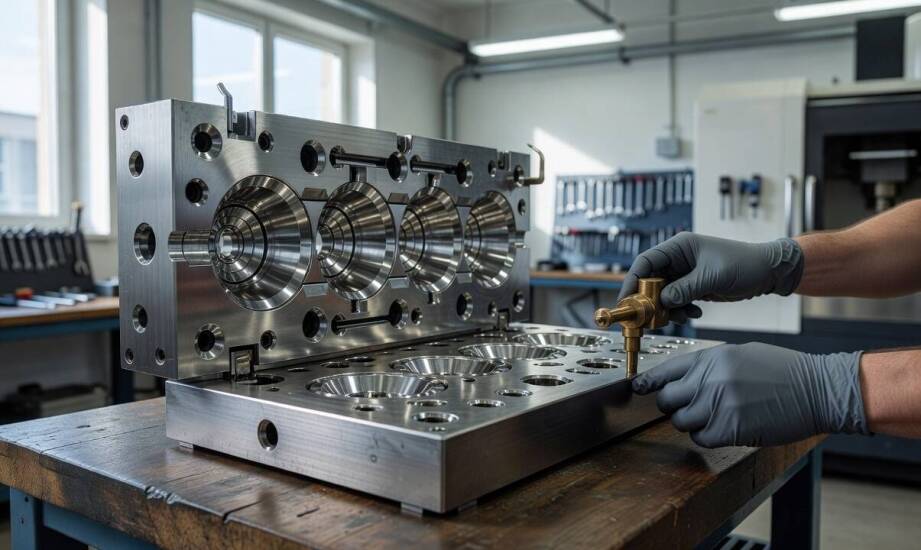
- Single-Cavity vs Multi-Cavity Moulds
- Does a Multi-Cavity Mould Always Have a Longer Cycle?
- Cold Runner or Hot Runner?
- Why Is There No Universal Production-Volume Threshold?
- How Does Cavity Count Affect Machine Requirements?
- Why Is Runner Balance Important in Multi-Cavity Tools?
- How Does Cooling Influence Multi-Cavity Production?
- How Does the Polymer Affect Mould Design?
- How Does Mould Construction Change as Cavity Count Increases?
- Why Does an In-House Tool Room Matter?
- How Should the Most Economical Mould Be Selected?
- FAQ
The same plastic part can require a very different mould design depending on the expected production volume.
Read more: Why are aluminium mats chosen for the entrance areas of buildings more and more often?
For a relatively small series, a simple single-cavity or low-cavity tool may provide the best overall economics. For long-running programmes with high annual demand, investing in a multi-cavity mould, more advanced cooling or a hot-runner system can significantly increase output and reduce the manufacturing cost per acceptable part.
Read more: What are the best materials for waterproof entrance doormats?
The most expensive mould is therefore not automatically the best solution.
Read more: Choosing PVC bar mats for high-traffic areas
The objective is to balance tooling investment against:
required production volume;
cycle time;
machine capacity;
material consumption;
maintenance;
expected programme life;
required product quality.
This decision should be made before the mould is manufactured, because cavity count and runner architecture influence both the initial cost and the economics of every subsequent production cycle.
Single-Cavity vs Multi-Cavity Moulds
A single-cavity mould produces one part per injection cycle.
Its construction is usually simpler, which can make tooling, process optimisation and maintenance easier.
A multi-cavity mould produces several identical parts during the same cycle.
Increasing cavity count can significantly increase output because more saleable parts are produced each time the mould opens.
The basic relationship is simple:
more cavities can reduce machine time per finished part, provided that the mould and injection moulding machine can operate all cavities consistently.
The challenge is maintaining equivalent conditions across the entire mould.
Each cavity should receive an appropriate amount of material under sufficiently similar thermal and pressure conditions.
As cavity count increases, greater attention must be paid to:
runner balance;
cooling balance;
venting;
pressure losses;
temperature distribution;
cavity-to-cavity dimensional variation.
A poorly balanced multi-cavity tool may produce acceptable parts in some cavities while others show short shots, flash, weight differences or dimensional variation.
Does a Multi-Cavity Mould Always Have a Longer Cycle?
Not necessarily.
Adding cavities increases the total amount of material processed during a shot, but this does not automatically determine the cycle time.
Cycle duration is influenced by several factors, including:
maximum wall thickness;
cooling efficiency;
runner dimensions;
polymer type;
mould temperature;
machine plasticising capacity.
A multi-cavity tool may therefore have a similar, slightly longer or, in some cases, differently optimised cycle compared with a single-cavity version.
What matters economically is not simply the number of seconds per moulding cycle but the number of acceptable parts produced during that cycle.
For example, even if a four-cavity mould requires slightly more time per shot than a single-cavity mould, its effective machine time per finished part may still be considerably lower.
Cold Runner or Hot Runner?
Runner design is another major factor influencing tooling cost and production economics.
Cold-runner systems
In a cold-runner mould, plastic fills both the part cavity and the runner channels.
The runner cools and solidifies together with the moulded component and is then ejected from the mould.
Depending on the polymer and quality requirements, this material may:
be recycled internally;
be reground and blended back into production;
be used elsewhere;
or become process waste.
The main advantages of cold-runner systems include:
lower initial tooling complexity;
generally lower investment cost;
easier maintenance;
relatively straightforward colour or material changes.
They can therefore be attractive for shorter runs, projects with frequent material changes or applications where runner material can be economically reused.
Hot-runner systems
In a hot-runner mould, heated manifolds and nozzles maintain the material in a molten state until it reaches the cavity.
This means that a conventional solid runner is not produced during every shot.
As a result, a hot-runner system can:
reduce runner-related material consumption;
simplify part separation;
support automation;
reduce cycle time when runner cooling would otherwise be a limiting factor.
The system is, however, more complex and requires additional components, temperature control and specialised maintenance.
It can also make colour changes or processing of certain heat-sensitive materials more demanding.
For this reason, hot runner does not automatically mean better.
The correct decision depends on the economics and technical requirements of the specific project.
Why Is There No Universal Production-Volume Threshold?
It is tempting to say that a cold runner is suitable below a particular annual quantity and that a hot runner becomes profitable above a fixed number of parts.
In practice, such thresholds can be misleading.
Consider two products manufactured in identical annual quantities.
One is a small part made from an inexpensive polymer with a very light runner.
The other uses an expensive engineering resin and has a cold runner weighing almost as much as the finished component.
The economic case for a hot-runner system may be completely different even though the annual volume is identical.
The calculation should therefore include:
annual number of parts;
cavity count;
runner weight;
part weight;
raw-material cost;
potential regrind rate;
cycle time;
hourly machine cost;
hot-runner investment;
maintenance requirements;
expected production lifetime.
Only this type of total-cost analysis provides a meaningful break-even point.
How Does Cavity Count Affect Machine Requirements?
Adding cavities also increases the demands placed on the injection moulding machine.
A larger tool may require greater:
shot capacity;
plasticising capacity;
clamp force;
platen area;
tie-bar spacing.
Clamp-force requirements are influenced by the projected area of all cavities and the pressures generated during filling.
For this reason, cavity count cannot be selected solely on the basis of desired production output.
A mould that is theoretically capable of producing a very high number of parts per cycle may be uneconomical if it requires a much larger and more expensive moulding machine.
The entire production cell must therefore be considered.
Why Is Runner Balance Important in Multi-Cavity Tools?
Molten polymer follows the runner network from the machine nozzle toward individual cavities.
If the flow path is poorly balanced, some cavities may fill earlier than others.
This can create differences in:
filling pressure;
holding pressure;
part weight;
shrinkage;
dimensions;
surface quality.
The objective is therefore to design the runner system so that cavities operate under sufficiently comparable conditions.
Balanced layouts can be achieved through appropriate runner geometry and, depending on the application, hot-runner design or more advanced gating strategies.
Flow simulation can support this process by allowing engineers to assess filling behaviour before steel is machined.
Simulation does not eliminate every production risk, but it can reveal potential problems while design changes are still relatively inexpensive.
How Does Cooling Influence Multi-Cavity Production?
Runner balance alone is not enough.
Each cavity should also experience sufficiently consistent cooling conditions.
If one section of the mould removes heat more effectively than another, parts from different cavities may show different:
shrinkage;
dimensions;
warpage;
surface appearance.
Cooling design becomes increasingly important as cavity count increases and the thermal load of the mould grows.
Well-designed cooling can also shorten the overall moulding cycle because cooling is often one of the longest stages of injection moulding.
For high-volume production, optimisation of the cooling system can therefore influence economics just as strongly as cavity count.
How Does the Polymer Affect Mould Design?
Different polymers behave differently during filling and cooling.
Important material characteristics include:
viscosity;
melt-flow behaviour;
shrinkage;
crystallinity;
thermal sensitivity;
processing temperature.
Semi-crystalline polymers such as polypropylene can show different and often greater moulding shrinkage than many amorphous polymers.
However, exact shrinkage should always be taken from the data for the specific grade and verified under real processing conditions.
It would be too simplistic to select cavity count or runner architecture solely according to whether a polymer is crystalline or amorphous.
The material, part geometry and process must be evaluated together.
How Does Mould Construction Change as Cavity Count Increases?
A higher-cavity mould generally requires more complex tooling.
Depending on the product, this may include:
multiple precision cavity inserts;
more complex runner systems;
additional cooling circuits;
slides or moving components;
more sophisticated ejection;
a larger and more rigid mould base.
The mould must withstand injection and clamping loads without excessive deformation.
Adequate stiffness and support at the parting line help reduce the risk of flash and maintain dimensional repeatability over long production runs.
When specifying an injection mould for plastic, these mechanical requirements should therefore be considered together with target output and unit cost.
Why Does an In-House Tool Room Matter?
Cooperation between mould designers and the injection moulding department can make production validation more efficient.
If a trial reveals the need to modify:
a cavity insert;
gate geometry;
venting;
cooling;
a dimensional feature,
access to an in-house tool room can shorten the feedback loop between testing and modification.
Noex combines plastic-part design, prototyping, mould manufacture and injection moulding within its own production environment.
The company operates CNC equipment in its tool room and manufactures injection moulds using CAD/CAM/CAE design processes.
Its injection moulding facility includes Wittmann-Battenfeld and Arburg machines, allowing projects to move from tooling trials to series production within the same manufacturing organisation.
How Should the Most Economical Mould Be Selected?
There is no universal formula stating that a certain annual quantity always requires a fixed number of cavities.
Instead, engineers should determine the lowest total manufacturing cost while maintaining the required quality and production capacity.
The analysis should answer several questions:
How many parts are required annually?
How long will the programme run?
What is the target cycle time?
How much does the polymer cost?
How much material would a cold runner consume?
Can the runner be reused?
Which injection moulding machine is required?
How much additional tooling investment does a higher cavity count require?
What maintenance does the proposed runner system require?
A single-cavity cold-runner tool can be the best solution for one project, while a multi-cavity hot-runner mould may clearly outperform it in another.
The economically optimal mould is the one whose cavity count, runner design, machine requirements and expected production life are matched to the actual programme rather than to a fixed industry rule of thumb.
Increasing cavity count can improve production output and reduce machine time per finished part.
Multi-cavity moulds require careful balancing of filling and cooling conditions.
Cold runners usually involve lower initial complexity but create a solid runner during every cycle.
Hot runners can reduce runner waste and cycle time but increase tooling and maintenance complexity.
There is no universal annual-volume threshold that determines when a hot runner or a specific cavity count becomes profitable.
Material properties, machine capacity and cooling design influence the economic result.
The best solution should be selected according to total cost per acceptable part over the expected production life.
FAQ
When does a multi-cavity mould become more economical than a single-cavity mould?
It becomes attractive when the additional tooling investment is offset by higher output and lower machine cost per finished part. The break-even point depends on annual volume, cycle time, machine rate, cavity count and the expected duration of the production programme.
Why is a hot runner not always the best choice?
A hot runner can reduce runner material and sometimes shorten cycle time, but it makes the mould more complex and more expensive to build and maintain. For shorter series or frequent material and colour changes, a cold-runner system can still provide better overall economics.
How does the polymer affect mould design?
The polymer influences flow behaviour, processing temperature, shrinkage, cooling and potential warpage. These characteristics affect runner design, gating, cooling and dimensional compensation within the mould.
Does increasing cavity count always reduce production cost?
Not automatically. More cavities increase output but also increase mould cost and may require a larger injection moulding machine. The cavity count is economical only when the additional production capacity is actually needed and used.
You might be interested

OEM, ODM, and Contract Manufacturing in Dietary Supplements: How They Affect Formula Control, Costs and Time to Market

How Does a Rubber Entrance Mat Stop Dirt Before It Reaches the Aluminum Mat?

How to Choose a Company for Kitchen Renovation?